PROJECT 002
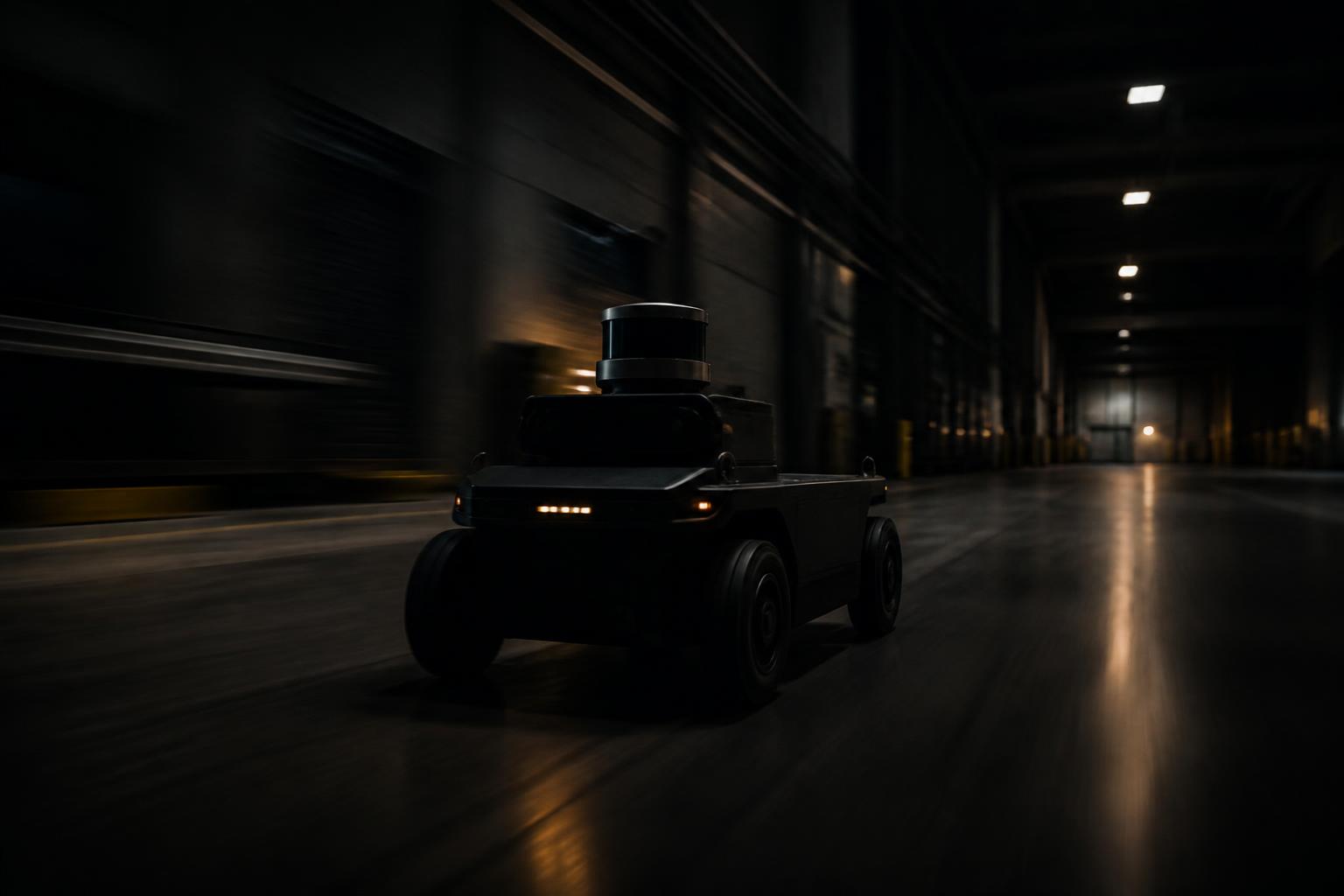
Autonomous Mobile Robot
An intelligent mobile platform combining perception, localization, planning and velocity control for real-world navigation.
- STATUS
- ACTIVE
- DOMAIN
- MOBILITY
- PLATFORM
- MOBILE BASE
- SENSING
- LIDAR / RGB
- PLANNING
- GLOBAL + LOCAL
- AI
- PERCEPTION
- CONTROL
- VELOCITY LOOP
Overview
A mobile robotics platform used to develop and validate navigation intelligence: localisation, obstacle understanding, global and local planning, and closed-loop velocity control on BLDC drives.
Problem
Indoor and industrial environments change constantly. Maps drift, obstacles move, floors vary and sensing is partial. Navigation stacks must remain safe and predictable when the world does not match the map.
Approach
- Build and maintain a map of the operating environment.
- Localise continuously against that map using range and visual cues.
- Plan a global route, then refine locally against live obstacle data.
- Convert plans into wheel velocity commands with a closed-loop drive controller.
- Record disengagements and near-misses to drive the next iteration.
System Architecture
- SENSING NODE — range and camera acquisition, filtering
- LOCALIZATION NODE — pose estimation and map alignment
- PLANNING NODE — global route + local reactive planner
- DRIVE NODE — BLDC velocity control, odometry
- SAFETY NODE — stop conditions, watchdogs, limits
Hardware
- Differential-drive mobile base (placeholder specification)
- BLDC motors with encoder feedback
- 2D/3D range sensing and forward camera
- Embedded real-time controller + on-board compute
AI Models
- Obstacle and free-space segmentation
- Scene classification for environment-aware behaviour
- Learned local planning policies under evaluation
Perception
Range and visual data are fused into an occupancy and semantic representation of the immediate surroundings, used both for safety and for planning.
Planning
A global planner produces a route over the map; a local planner continuously re-solves a short-horizon trajectory against live obstacles and dynamic constraints.
Control
Velocity setpoints are tracked by a closed-loop BLDC controller with acceleration limits and hard safety cut-offs.
Results
Placeholder — navigation reliability metrics will be reported here once measured under a defined test protocol.
Technical Notes
- Reality is the benchmark: simulated navigation success is treated as a hypothesis, not a result.
- Hardware specification is indicative and will be finalised per deployment.
Source
Have a physical
AI problem?
Whether you are exploring a new robotic application, looking to automate a physical process, or developing the next generation of intelligent machines, let's build it.