PROJECT 001
General-Purpose Manipulation
A robotic manipulation system combining visual perception, grasp generation, motion planning and real-time control.
- STATUS
- ACTIVE
- DOMAIN
- MANIPULATION
- PLATFORM
- ROBOT ARM
- SENSING
- RGB-D
- PLANNING
- MOTION PLANNING
- AI
- VISION / VLA
- CONTROL
- REAL-TIME
Overview
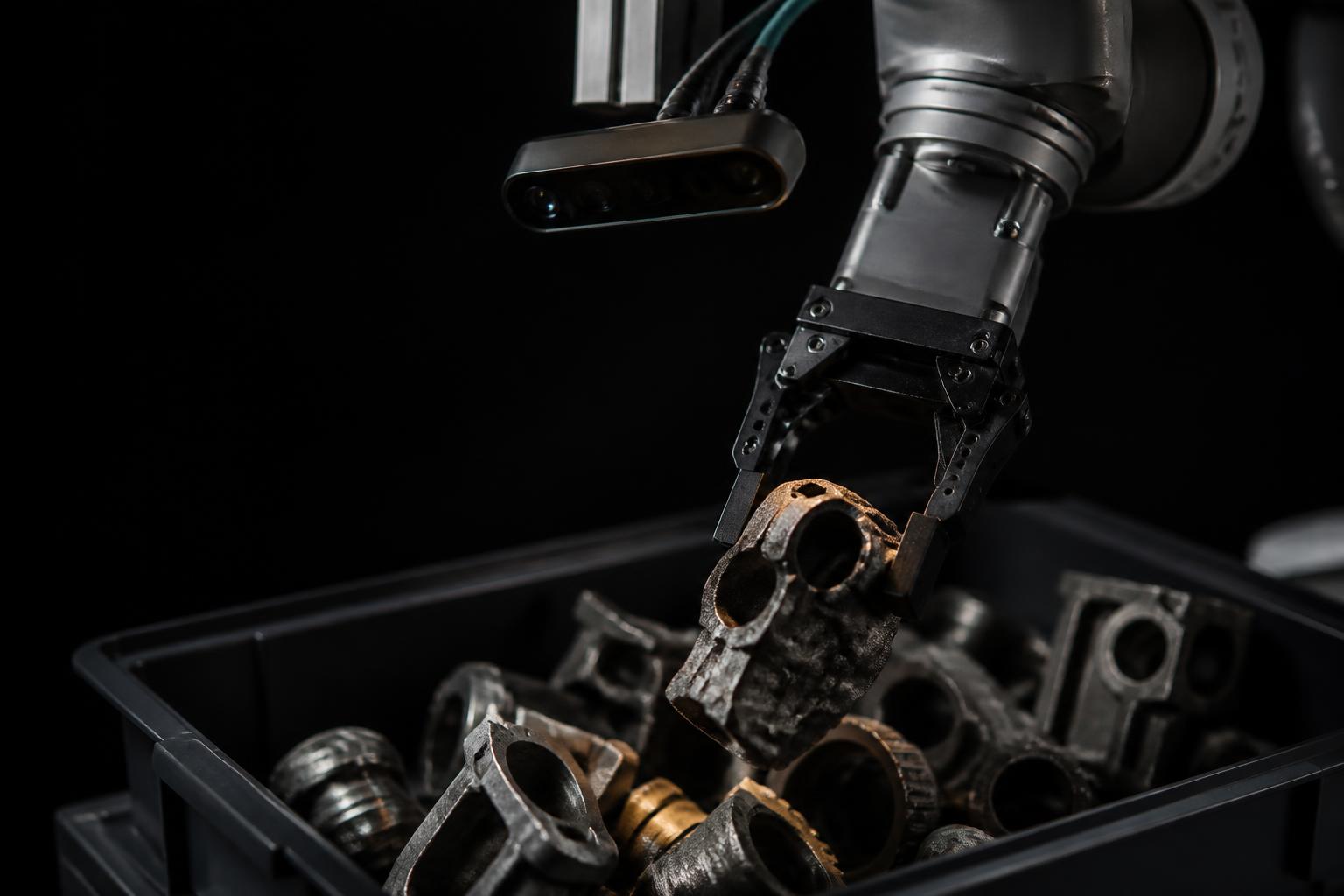
An internal development platform for general-purpose manipulation: a robot arm that can locate, grasp and place objects it has not been explicitly programmed for. The system is used as a testbed for perception models, grasp policies and planning strategies under real contact dynamics.
Problem
Most deployed manipulation is scripted against fixed fixtures and known parts. Once object pose, geometry or lighting varies, scripted pipelines fail. The problem is building a stack that degrades gracefully under imperfect perception, partial observability and contact uncertainty.
Approach
- Capture RGB-D observations of the workspace and reconstruct a task-relevant scene representation.
- Generate candidate grasps and rank them against reachability, stability and task constraints.
- Plan collision-free trajectories to the selected grasp and to the placement target.
- Execute with a real-time controller and monitor deviation between intent and physical outcome.
- Log every execution as training and evaluation data for the next iteration.
System Architecture
- PERCEPTION NODE — RGB-D acquisition, calibration, segmentation, pose estimation
- GRASP NODE — candidate generation, scoring, selection
- PLANNING NODE — inverse kinematics, collision checking, trajectory optimisation
- CONTROL NODE — real-time joint/servo loop with safety limits
- DATA NODE — execution logging, replay and evaluation
Hardware
- Multi-DOF robot arm (placeholder — replace with deployed platform)
- Parallel-jaw gripper
- RGB-D camera, eye-to-hand calibration
- On-board compute with GPU acceleration
AI Models
- Segmentation and object detection for workspace parsing
- 6-DoF pose estimation for known geometries
- Learned grasp scoring; VLA models evaluated for instruction-conditioned behaviour
Perception
Depth and colour streams are fused into a workspace representation containing object masks, approximate geometry and pose estimates, with explicit handling of missing and noisy depth.
Planning
Task goals are decomposed into reach, grasp, transfer and place phases. Each phase is solved as a constrained trajectory problem with collision and joint-limit checks.
Control
A real-time control loop tracks planned trajectories, enforces velocity and force limits, and aborts safely on unexpected contact.
Results
Placeholder — quantitative benchmarks are being defined and will be published here once measured on the deployed platform. No performance figures are claimed at this stage.
Technical Notes
- Simulation is used for policy iteration; every result is re-validated on hardware.
- Evaluation protocol and datasets are being formalised.
Source
Have a physical
AI problem?
Whether you are exploring a new robotic application, looking to automate a physical process, or developing the next generation of intelligent machines, let's build it.